With the rapid development of Large Language Models (LLM), computer vision, and multimodal models, the global demand for high-density computing resources is climbing rapidly. Both top-tier cloud service providers and local data centers are accelerating their upgrades to AI server architectures. This wave not only drives a massive transformation of data center infrastructure but also brings the entire supply chain into a new phase across technology, manufacturing, and verification.
Facing growing AI application demands, what technical upgrades do AI servers need? What challenges will electrical safety testing face?
Driven by generative AI, China has become one of the fastest-growing markets for AI servers globally. Supported by policy, industrial digitalization upgrades, and large model training demands, the deployment volume of AI IaaS and GPU clusters continues to increase. High-density servers, liquid cooling, and high-power cabinets have become mainstream trends in data center upgrades.
Meanwhile, Southeast Asian countries such as Singapore, Malaysia, and Indonesia, driven by the popularization of cloud services, the layout of multinational tech companies, and local autonomous computing needs, are also accelerating the construction of regional data centers and AI cluster bases.
As the AI infrastructure in these two major markets continues to expand, AI server technology must also upgrade simultaneously to meet higher requirements for high-power GPUs, liquid cooling, high-speed optical communications, rack power supply design, and the IEC 62368-1 electrical safety standard. Technological innovation and compliance will become key thresholds for the supply chain to enter the domestic and Southeast Asian markets, and also the core of future AI infrastructure competitiveness.
The power consumption and thermal density of AI servers have surpassed the limits of traditional servers. Their role is expanding from a pure hardware product to an overall system solution, making customer requirements for compliance and auditing increasingly strict.
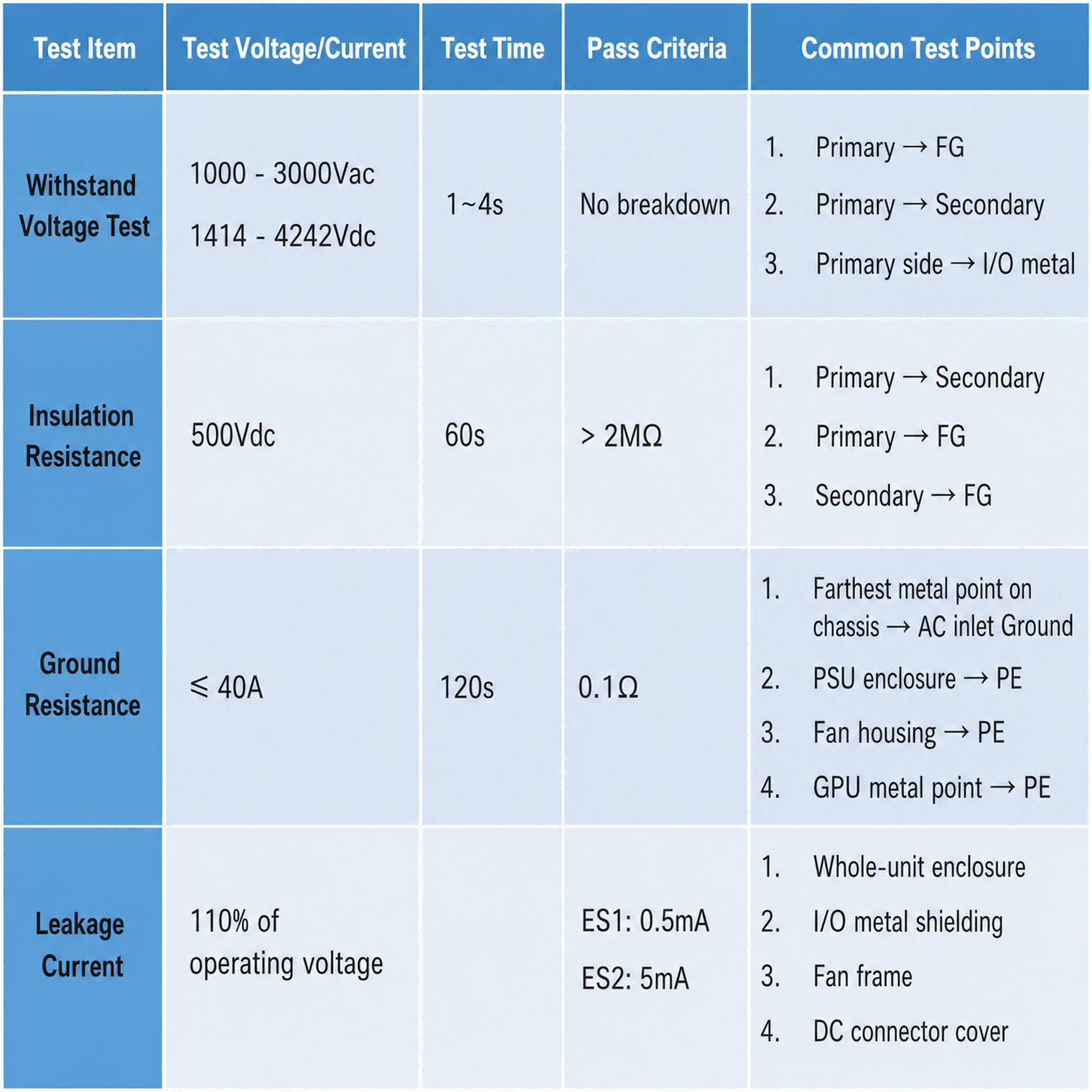
AI servers mainly follow IEC 62368-1 for international safety certifications. To enter the domestic market, they must comply with the GB 4943.1 Information Technology Equipment Safety Standard (equivalent to IEC/EN/UL 62368-1). Common electrical safety tests include withstand voltage (hipot), leakage current, insulation resistance, and grounding resistance, to confirm sufficient isolation between high and low voltage, and that no dangerous currents are generated on the housing or interface metal parts.
The table below lists the testing items and qualification conditions for GB 4943.1 safety certification:
Suppliers are gradually advancing towards "high power," "increased thermal density," and "rapid mass production and stability" to meet the emerging demands of the market. In this process, ensuring the long-term stable operation of systems under high-voltage conditions becomes a significant challenge. Server products must pass safety compliance tests before leaving the factory, and many enterprises require the submission of qualified safety test reports before making purchases. Therefore, the efficiency of passing these safety tests directly impacts manufacturing efficiency and market competitiveness.



 400-616-5217

 Location:



 粤公网安备 44030502008393号