Power measurement is an indispensable element in electrical system evaluation. Oscilloscopes are widely used for waveform observation, debugging, and noise analysis, but they are not designed to provide the accuracy required for reliable power analysis. In scenarios such as efficiency evaluation, compliance verification with standards, and product quality assurance, accurate measurement is critical.
This article summarizes the limitations of oscilloscopes in power measurement and introduces alternative methods to achieve the required accuracy and reliability in today's rigorous testing environments.
Measuring inverter efficiency with an 8‑channel oscilloscope
Take a common measurement configuration for an inverter with DC input and three‑phase AC output.
Channels needed: 8 channels total
-
DC voltage ×1
-
DC current ×1
-
AC voltage ×3
-
AC current ×3
Equipment required:
-
8‑channel oscilloscope
-
High‑voltage differential probes ×4
-
AC/DC current probes (with power supply) ×4
-
PC and waveform analysis software
This configuration is not only bulky and expensive, but also involves complex wiring and setup that are prone to errors.
Moreover, synchronization and analysis become more difficult due to high‑frequency components, switching noise, frequency fluctuations, and other factors.
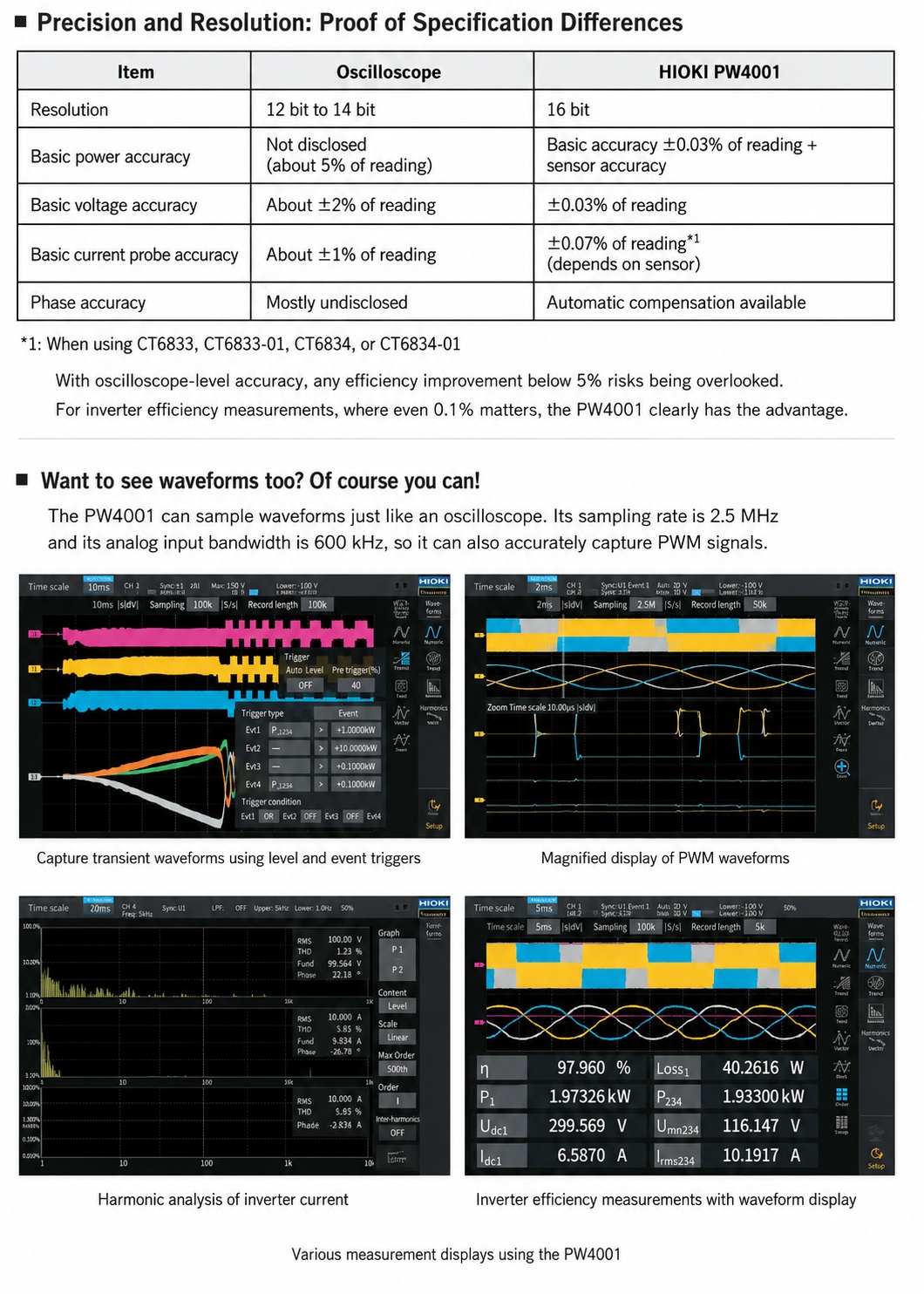
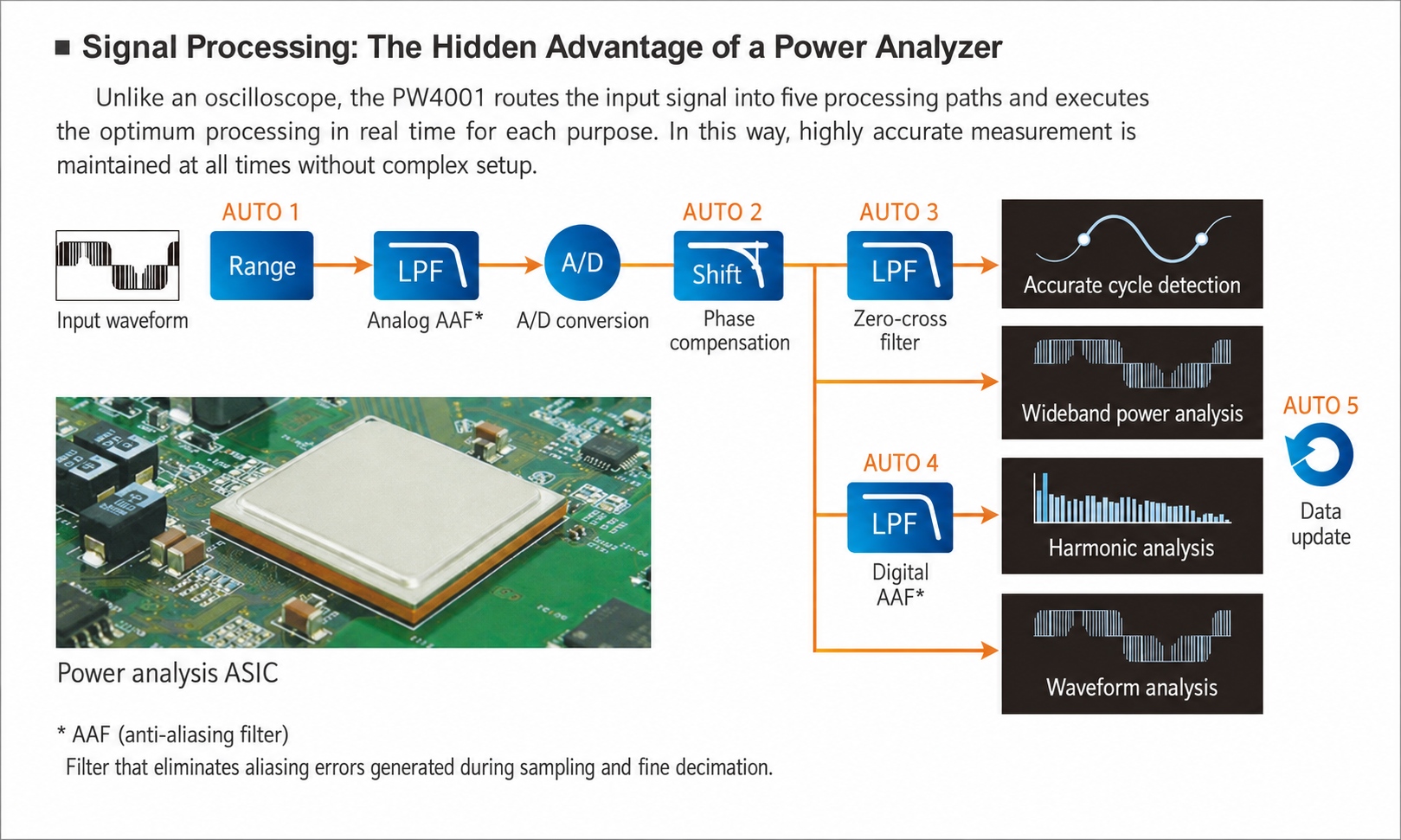
This complex measurement can be solved with the HIOKI Power Analyzer PW4001.
-
4 voltage channels + 4 current channels = 4 power channel measurement
-
No differential probe needed; direct high‑voltage input
-
Use clamp sensors for safe and high‑accuracy current measurement
-
Real‑time display of efficiency, power factor, power, energy, harmonics
-
No need for power parameter calculation programs – measure on‑site immediately after connection
-



 400-616-5217
 Location:



 粤公网安备 44030502008393号