With the rapid development of electric vehicles, energy storage systems, and charging equipment markets, and driven by the trend toward lightweight design, the voltage and power that wiring harnesses must bear have to be greatly increased. Traditional wiring harness application voltages have gradually risen to 600V, 800V, or even above 1000V. This change imposes stricter requirements on the withstand voltage performance of insulating materials, terminal structure design, and overall testing and verification standards.
In this context, it is crucial that wiring harness designs comply with relevant regulations such as UL758/UL62 (corresponding to GB/T5023), ISO6722/ISO19642 (corresponding to GB/T25085), and SAE J1654/J1128.
Electric vehicles are subject to international standards ISO26262 (corresponding to GB/T34590) and IEC61508 (corresponding to GB/T20438), so wiring harness designs must meet strict functional safety levels.
-
Systematic perspective: The wiring harness is no longer regarded as a single component but is evaluated as an important part of the overall safety system.
-
Full-process optimization: Functional safety thinking must run through the three core stages of design, material selection, and verification.
-
Failure response capability: The core design goal is to ensure that the system remains in a "controllable" and "safe" state even under extreme environments or in the event of failures.
With the proliferation of electric vehicles, high-power equipment, and industrial automation systems, the safety of wiring harnesses under high-voltage conditions has become increasingly important. Withstand voltage testing has become an indispensable key step in wiring harness design, manufacturing, and outgoing inspection, with the purpose of ensuring sufficient insulation reliability under actual operating conditions. Functional safety standards such as ISO26262 (corresponding to GB/T34590) and IEC61508 (corresponding to GB/T20438) have had a profound impact on wiring harness design.
The main purpose of withstand voltage testing is to verify the insulation integrity between conductors within the wiring harness, as well as between conductors and the housing or shielding layer. By applying a test voltage higher than the normal working voltage, insulation defects can be detected early, preventing future problems such as leakage, breakdown, or short circuits, thereby reducing potential safety risks of electric shock to personnel and damage to equipment.
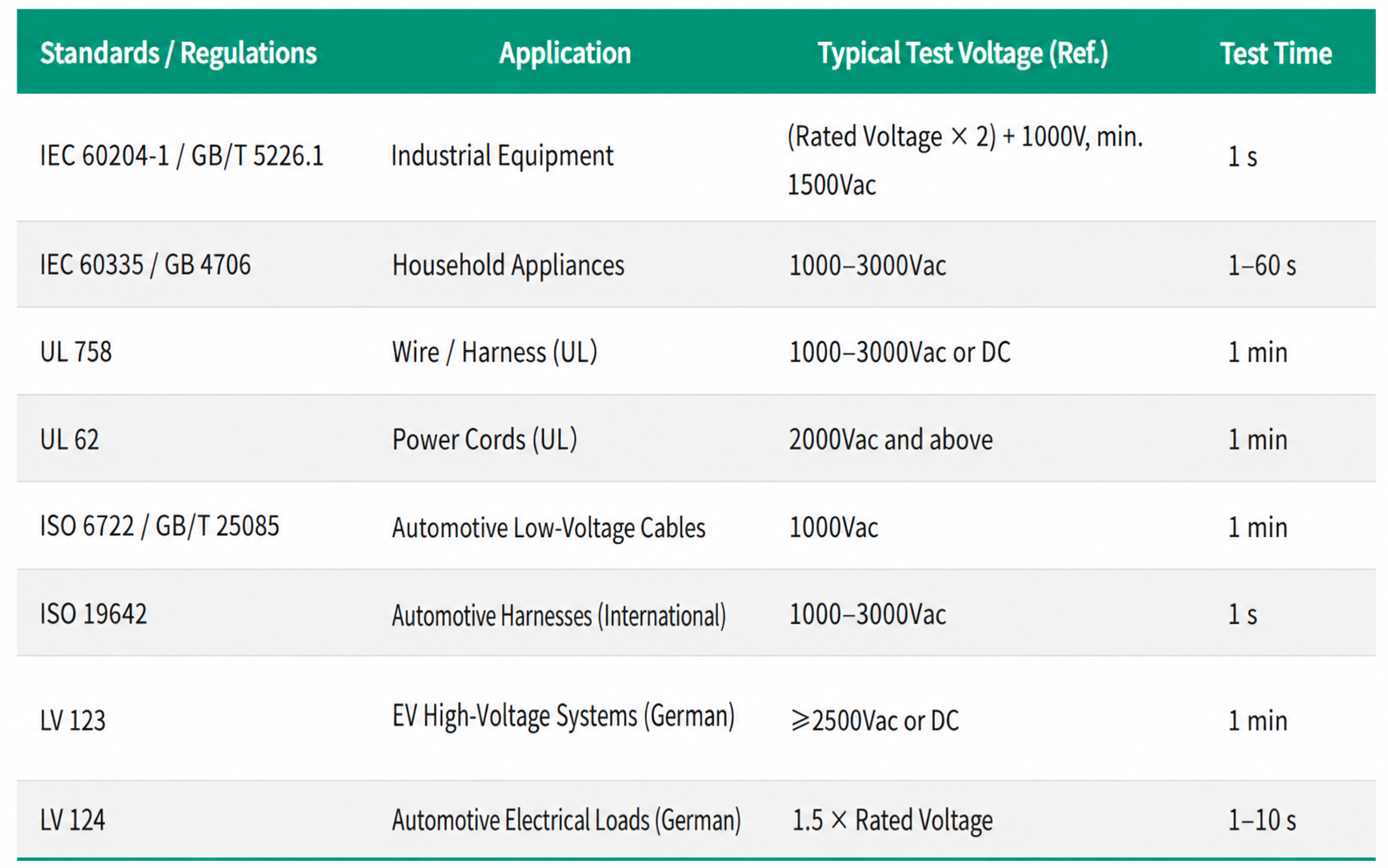
Different application fields have corresponding domestic and international regulatory requirements. Common standards and specifications include:



 400-616-5217

 Location:



 粤公网安备 44030502008393号