With the rapid development of automotive electrification, batteries, motors, and inverters have become indispensable core components. These devices are subject to high currents during operation; even a slight connection defect can cause overheating, severely affecting product performance and safety. Among them, battery heating is particularly prominent. During ultra‑fast charging of PHEVs and BEVs, large currents may cause abnormal heating due to poor connections, which not only shortens the lifespan of power transmission and distribution but may even lead to fires. Therefore, welding quality inspection in the manufacturing process is crucial.
Large‑scale energy storage systems (ESS) face the same issue. With the growing adoption of renewable energy, the demand for ESS continues to rise. The connection quality of such systems is directly linked to system efficiency and safety, thus requiring high durability for long‑term use.
To address these challenges, Hioki’s RM3546 for motors, with its “1 nΩ resolution” and “powerful temperature compensation function (A‑TC function)”, achieves high‑precision resistance measurement. It can not only detect the busbar welding and internal cell connection quality of EV batteries, but also be applied to connection quality inspection in motor and inverter manufacturing, helping to improve product safety and energy efficiency.
Temperature influence on welding resistance measurement
When measuring welding resistance, the test object just after welding is at a high temperature.
Because temperature rise intensifies thermal vibration of metal atoms, hindering free electron movement, the resistance value of metals increases with temperature. Due to this temperature dependence of resistance, measurements taken at different temperature states (e.g., after welding) will not yield accurate results.
The previous model RM3545 was equipped with a temperature correction (TC) function*, which obtains temperature information by connecting a temperature sensor and corrects the resistance value to that at a standard temperature.
However, this method has two drawbacks and is not suitable for test objects that are at high temperatures immediately after welding:
-
Difficulty in achieving high‑speed and precise temperature measurement
-
The temperature changes drastically after welding, generating thermal electromotive force and increasing errors.
To solve these issues, the RM3546 adds a new “Advanced Temperature Correction (A‑TC) function” that overcomes the shortcomings of the conventional method and enables more accurate measurement.
A‑TC Function
The A‑TC function is a new TC function that does not require an external temperature sensor.
It achieves temperature sensing through resistance measurement* and compensates for time‑varying thermal electromotive force with a unique algorithm*², allowing rapid conversion of resistance values to values at a standard temperature regardless of the temperature state of the test object.
The following section explains the measurement procedure in detail based on actual experimental data.
*1: Based on the same principle as the AOT function equipped in the RM series – a function that converts the resistance value of the test object to a value at a target temperature using information on “resistance value at a certain temperature” and “temperature coefficient”.
*2: The RM3546 is equipped with the A‑OVC (Advanced‑Offset Voltage Compensation) function, which has improved tracking capability for changes in thermal electromotive force compared to the OVC function of previous RM series.
Example of equipment configuration
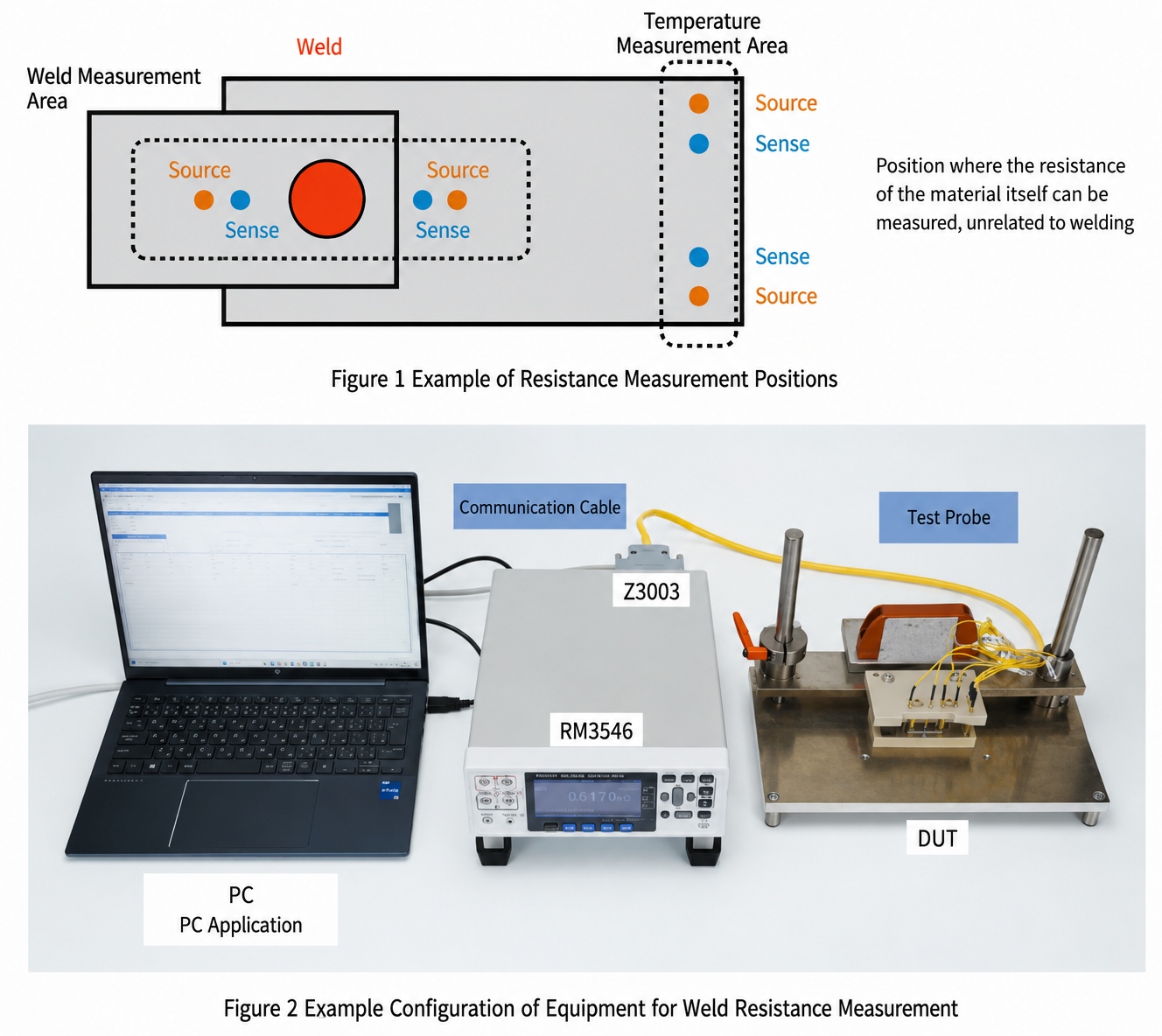
When using the A‑TC function, in addition to the welded measurement point, it is also necessary to measure the resistance value of the non‑welded area of the DUT to obtain temperature information. Therefore, measurements at two positions are required as shown in Figure 1. Since both resistance measurements require high accuracy, each must be wired using the 4‑terminal connection method. Specifically, wiring can be done from the multiplexer unit Z3003 on the rear panel of the RM3546, as shown in Figure 2.



 400-616-5217

 Location:



 粤公网安备 44030502008393号