The state in which the output voltage remains unchanged even when the load changes is called Constant Voltage mode. The state in which the output current remains unchanged even when the load changes is called Constant Current mode. Their English abbreviations are CV (Constant Voltage) and CC (Constant Current), respectively.
The output of a regulated power supply can be expressed by two quantities: voltage (unit: V) and current (unit: A). Focusing on voltage, when the voltage remains constant regardless of changes in the load, this operation is called constant-voltage operation. For example, if the output voltage Eo is 10 V and a 10 Ω load RL is connected, the output current Io can be calculated using Ohm’s law: Io = Eo/RL = 10 V/10 Ω = 1 A. Even when the load changes to 10 Ω, 20 Ω, 30 Ω, etc., the output voltage remains at 10 V. A source that operates in this way is called a constant-voltage source. Dry-cell batteries and storage batteries behave in a manner very similar to constant-voltage sources.
In an actual constant-voltage power supply, because the output power is limited, the current is also limited. (Kikusui products allow the current limit to be set freely using the current-setting knob.) When the output current reaches the limit, the output voltage will decrease, the C.V indicator will turn off, and the CC indicator will turn on. In addition, even if the load resistance is reduced all the way to a short circuit, the output current will not exceed the set value. This is the constant-current characteristic.
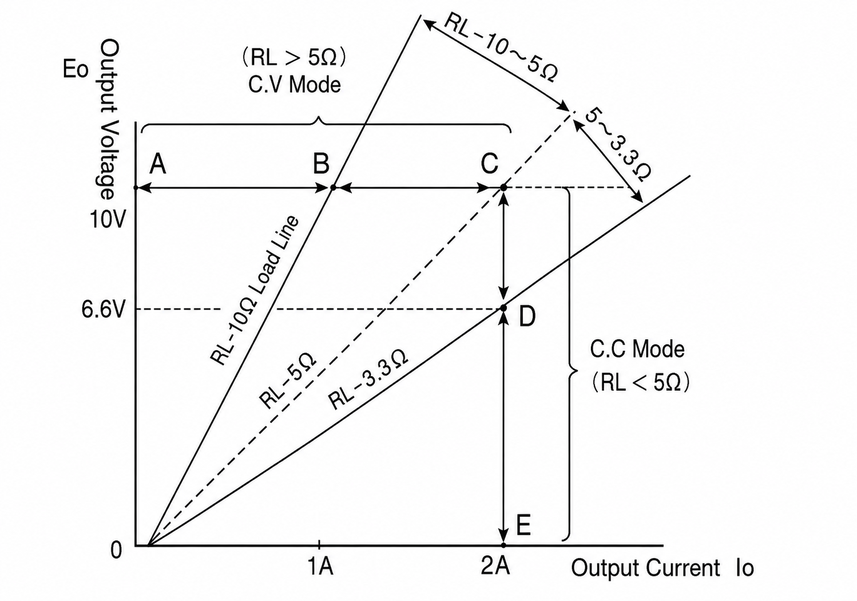
A regulated power supply can automatically transition from constant-voltage operation to constant-current operation, as shown in the figure above, thereby preventing excessive current from flowing into the load. This is referred to as automatic CV/CC crossover operation. The operating point can be represented by drawing a load line within the operating region shown in the figure.
When the output voltage Eo = 10 V and the current limit is set to 2 A, the operating point is at point A under no-load conditions. When RL = 10 Ω, the operating point moves to point B. When RL = 5 Ω, the operating point moves from point C to point D and enters the constant-current region. Point C is called the crossover point. When the load resistance is RL = 3.3 Ω, the output voltage is Eo = Io × RL = 2 A × 3.3 Ω = 6.6 V. If the resistance is further reduced until the output is short-circuited, the operating point reaches point E.
The output of a regulated power supply can be expressed by voltage (unit: V) and current (unit: A). Focusing on current, when the current remains constant regardless of changes in the load, this operation is called constant-current operation.
For example, when a constant-current power supply with an output current set to 2 A is connected to a load RL of 3.3 Ω, the output voltage Eo can be calculated using Ohm’s law: Eo = Io × RL = 2 A × 3.3 Ω = 6.6 V. With a 5 Ω load, the voltage is 10 V; with a 10 Ω load, it is 20 V. As the load resistance increases, the output voltage also increases so that the power supply can continue supplying the set current of 2 A. In an actual constant-current power supply, however, the output voltage cannot increase without limit and is restricted to a certain value. (Kikusui products allow this limit to be freely set using the voltage-setting knob.) Refer to the figure below for this characteristic.
When the constant-current value is set to 2 A, the voltage limit is set to 10 V, and a load RL = 3.3 Ω is connected, the operating point is at point D. When the resistance is increased to RL = 5 Ω, point D moves to point C. When the resistance is further increased to RL = 10 Ω, the operating point moves from point C to point B and enters the constant-voltage region. At this point, the output current decreases accordingly, meaning that the power supply is no longer operating in constant-current mode.
If RL is increased further until the circuit is finally in an open-circuit condition, the operating point moves from point B to point A. This prevents a voltage of 10 V or higher from being applied to the load. In other words, the power supply automatically transitions from constant-current operation to constant-voltage operation to protect the load. As shown in the figure above, operating point C is the crossover point.
In CV/CC mode, the power supply automatically switches operating modes according to changes in the load. The point at which the operating mode switches is called the crossover point.
For example, during CV-mode operation, if a change in the load causes the output current to reach the current limit, the power supply automatically switches to CC mode to protect the load. Similarly, during CC-mode operation, if the output voltage reaches the voltage limit, the power supply switches to CV mode.
This product can operate as both a constant-voltage power supply and a constant-current power supply. The operating state of a constant-voltage power supply is called Constant Voltage (CV) mode, while the operating state of a constant-current power supply is called Constant Current (CC) mode. The operating mode is determined by the following three parameters:
-
Output voltage setting
-
Output current setting
-
Load resistance
Simply put, when a load is connected normally, if you want the device to enter CV mode, keep the voltage setting fixed and increase the current setting. If you want the device to enter CC mode, keep the current setting fixed and increase the voltage setting.



 400-616-5217

 Location:



 粤公网安备 44030502008393号