Phase change is the process by which a substance transitions from one physical state (phase) to another under continuous changes in external parameters (such as temperature, pressure, magnetic field, etc.). For example, the three-state changes of water (gas, liquid, solid) are a vivid demonstration of phase change. And it is this seemingly ordinary phenomenon that, through the electrical variation laws hidden behind it, accidentally sparked a revolution in storage technology. Today, let us understand what phase-change memory is and the electrical characterization testing solutions for its materials and devices.
What is phase-change memory?
The first person to discover that phase change in materials causes changes in electrical properties was Stanford Ovshinsky, known as the "father of solar photovoltaic." As early as 1968, Ovshinsky found that certain glasses exhibit reversible changes in electrical resistance during phase change, and he first described a memory concept based on phase-change theory: during the transition of a material from an amorphous state to a crystalline state and back to the amorphous state, the amorphous and crystalline states show different optical and resistive properties. Therefore, the amorphous and crystalline states can be used to represent "0" and "1" respectively for data storage. This theory is called the Ovshinsky electronic effect.
Phase-change memory
Phase-change random access memory (abbreviated as PCRAM or PCM) is a type of non-volatile memory that uses electrical energy (heat) to switch the phase-change material between the crystalline state (low resistance) and the amorphous state (high resistance) to achieve information storage and erasure, and reads information by measuring resistance changes. Intel's phase-change memory uses chalcogenides, while Numonyx's phase-change memory uses a synthetic material containing germanium, antimony, and tellurium, known as GST. Regardless of the material chosen, phase-change memory stores information by exploiting the difference in electrical conductivity between the crystalline and amorphous states of the material. PCM simultaneously possesses attributes related to NOR Flash, NAND Flash, DRAM, or EEPROM, making it a major direction in memory development.
In the amorphous state, GST material has short-range atomic order and low free electron density, resulting in high resistivity. Since this state usually appears after a RESET operation, it is generally called the RESET state. In the RESET operation, the temperature of the device under test (DUT) rises slightly above the melting point, and then the GST is rapidly quenched to cool it down. The resistance of the amorphous layer can typically exceed 1 MΩ. In the crystalline state, GST material has long-range atomic order and high free electron density, resulting in low resistivity. Since this state usually appears after a SET operation, we generally call it the SET state. In the SET operation, the material temperature rises above the recrystallization temperature but below the melting point, and then it cools slowly, allowing crystal grains to form barriers. The resistance of the crystalline state typically ranges from 1 kΩ to 10 kΩ.
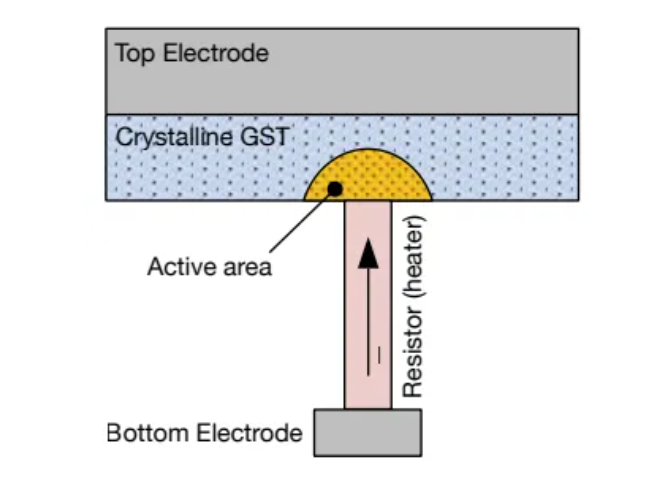
The typical structure of a PCM device consists of a top electrode, crystalline GST, amorphous/crystalline GST, thermal insulator, resistor (heater), and bottom electrode.



 400-616-5217

 Location:



 粤公网安备 44030502008393号